

Understanding GHB addiction begins with familarising yourself with the substance. GHB is a central nervous system depressant; it slows brain activity and creates feelings of relaxation and lowered inhibitions. It’s also one of the hardest substances to stop using safely without medical support.
At Castle Craig, we have experience treating GHB dependence. Very few people set out to get addicted to GHB, and it isn’t a sign of weakness or a lack of willpower. GHB addiction can happen to anyone, and it’s a medical condition that responds well to treatment.
Whether you’re researching this for yourself or for someone in your life, knowing what that treatment involves can make that first step feel less daunting.
What is GHB addiction?
Table of Contents
Understanding GHB dependence and withdrawal
-
How GHB addiction develops
Anyone who uses GHB regularly can develop dependence. GHB acts on the parts of the brain that control how alert and relaxed you feel. The brain adapts to that surge and begins to expect it.
As tolerance increases, higher doses bring stronger GHB side effects, including:
- Drowsiness
- Vomiting
- Mood swings
- Respiratory problems
The difference between a dose that feels fine and one that causes harm can be small; something exasperated by the fact that people often take GHB in small, repeated doses through the day or night to avoid withdrawal.
Since the more you take and the more your brain adapts – the more dependent you become. Complete dependence can develop before you realise what’s happening, and by the time you do, stopping without professional help becomes challenging.
-
Recognising the signs of GHB addiction
GHB dependence shows up differently for different people, but some patterns tend to repeat. These include:
- Using more than you meant to
- Feeling unable to cut back or stop, even when you want to
- Spending more of your time thinking about GHB, using it, or recovering from it
- You might stop doing things you used to enjoy, or seeing people you used to see.
- You might keep using GHB even though you can see it’s causing problems.
Cravings are common, and withdrawal symptoms begin when those cravings go unmet.
-
GHB, chemsex and the importance of non-judgmental care
GHB is one of the drugs most often used in chemsex. Chemsex means using drugs to help or heighten sexual experiences. Men who have sex with men are the group most commonly linked with chemsex, but people of many different identities have chemsex-related experiences.
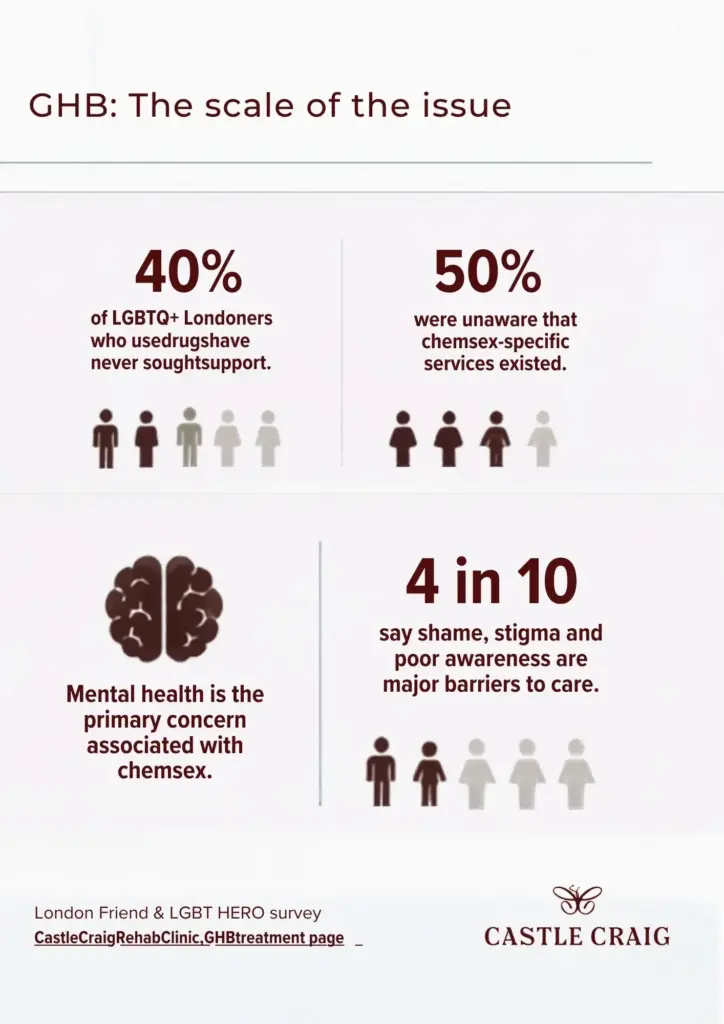
Research involving 2,428 men who have sex with men across Scotland, Wales, Northern Ireland and the Republic of Ireland found that 8.2% had used chemsex drugs in the past year. A 2024 UK survey found that those reporting chemsex-associated drug use more frequently reported a long-term limiting mental health condition than those who did not.
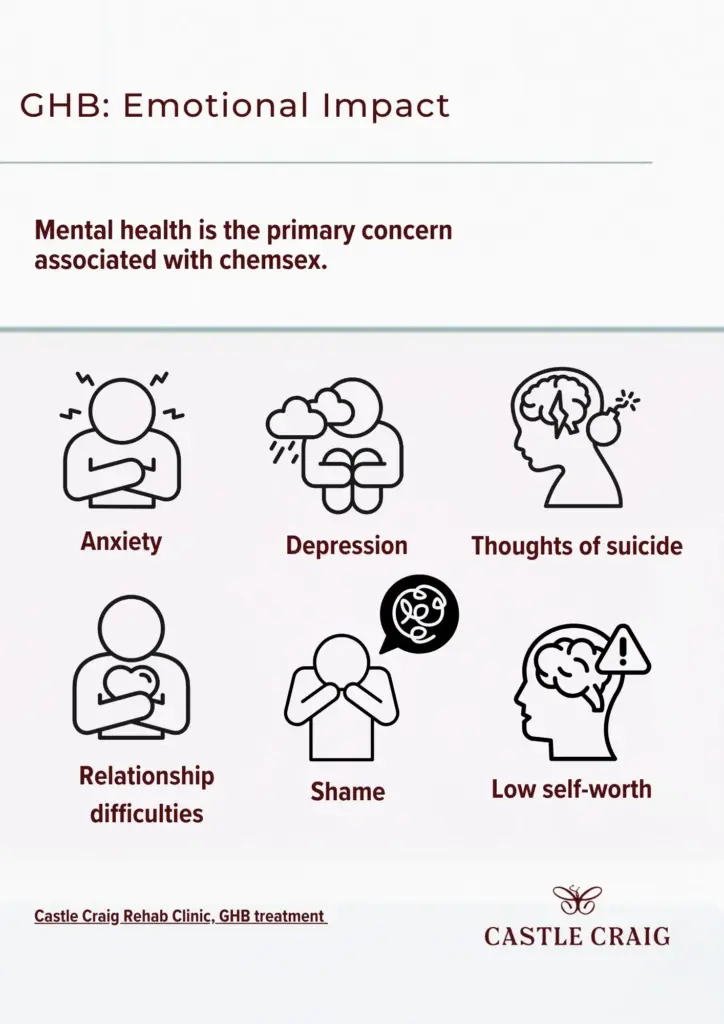
Many people who use GHB in a chemsex context are also living with mental health challenges, questions about their own identity, and other experiences that are hard on their own. These co-occurring conditions need to be addressed together during treatment.
The small difference between a recreational dose and a harmful one becomes more dangerous in a chemsex context. Repeated dosing across sessions that may last days, combined with other substances, significantly increases the risk of overdose.
This is sometimes called “going under” and needs immediate medical attention. A GHB overdose is a medical emergency. The signs include difficulty breathing, seizures, vomiting, and loss of consciousness.
If you think someone has overdosed, call 999 straight away.
Castle Craig treats people of every identity. While discussing the context and reasons for your GHB use may be necessary for treatment, our non-judgmental approach to GHB rehab treatment is the same as any other medical treatment.
“During my stay at Castle Craig I was made to feel accepted and safe. It is a beautiful place with very caring staff. For me it was a life changing experience. And helped me so much. I’m looking forward to the future one step at a time.”
GHB withdrawal: why medical supervision matters
-
GHB withdrawal symptoms
GHB withdrawal symptoms usually begin around 12 hours after the last dose and can continue for about 15 days. How long it lasts depends on how much GHB you were using, how often, and for how long.
Psychological symptoms can include:
- Confusion
- Anxiety
- Agitation
- Paranoia
- Hallucinations
Physical symptoms can include:
- Insomnia
- Increased heart rate
- Nausea
- Sweating
- Shaking
GHB withdrawal can become severe enough to be a medical emergency.
Symptoms can include rapid heart rate, hallucinations, and in serious cases, coma.
It’s not safe to go through it without medical support, even if you believe you have a “mild” dependency or you’ve quit successfully before.
-
Why GHB withdrawal requires specialist care
GHB quickly produces physical dependence, and severe withdrawal symptoms can happen even after short-term use. This makes GHB different from many other substances, and it makes stopping suddenly especially dangerous.
GHB withdrawal looks similar to alcohol withdrawal. The risk of delirium in GHB withdrawal is higher than in alcohol withdrawal, and managing it may need higher doses of medication than expected.
GHB withdrawal can’t be managed safely at home or at an outpatient clinic. It needs somewhere with medical staff who can monitor you around the clock.
GHB detox is not routinely carried out at Castle Craig. The nature of GHB withdrawal — which can be acute, unpredictable, and in some cases medically serious — means that the majority of cases require a level of acute medical management that sits outside a residential addiction setting.
In exceptional circumstances, where clinical assessment indicates it is appropriate, detox can be managed on site in a dedicated medical unit with 24-hour nursing and medical cover. Where withdrawal is complex or other health conditions are present, Castle Craig works closely with local hospitals and can arrange transfer to a general medical ward.
You can read more about what drugdetox involves.
GHB addiction treatment – what to expect at Castle Craig
-
Medically supervised GHB detox
At Castle Craig, drug detox takes place in a dedicated medical unit with 24-hour nursing and medical cover. The clinical team assesses each person on arrival and builds a withdrawal plan around what they need.
We use medication where it’s needed, taking a careful, gradual approach, and adjusting it based on how withdrawal progresses. Where withdrawal doesn’t respond as expected, or where there are other co-existing health conditions, we work closely with local hospitals and can arrange transfer to a general medical ward.
After detox, your tolerance to GHB will have dropped. If you use again at the dose you were taking before, your risk of overdose is much higher than it was before treatment. The next stages of treatment after detox prevent a relapse at the time when you are most at risk.
-
Residential rehab for GHB addiction
Residential drug addiction treatment is particularly suited to GHB dependence. Because GHB withdrawal can be unpredictable, you need close monitoring in the early stages.
Beyond that, recovery involves psychological work, and that work goes better with some distance from the places and routines tied to your GHB use.
The residential programme at Castle Craig combines individual therapy, group therapy, Cognitive Behavioural Therapy (CBT), and 12 Step facilitation. We build your treatment plan around your initial assessment.
-
Dual diagnosis and mental health support
GHB dependence often comes with other mental health needs, including anxiety, depression, and trauma-related conditions like PTSD.
At Castle Craig, we assess mental health at admission and treat it alongside the addiction, at the same time, with the same clinical team.
-
Life after treatment – continuing care
All Castle Craig patients receive a one-year aftercare plan on leaving. It’s part of the treatment, designed to protect the progress you made during your residential stay and support you through the periods when relapse risk is highest.

Download Our Brochure
If someone in your life is affected by GHB use
GHB use can be difficult to recognise from the outside. It doesn’t always look like a conventional addiction. Someone using GHB may seem fine between sessions, and they might use it only every few days or weeks rather than daily. This can make it hard to know what you’re seeing or how seriously to take it.
GHB dependence tends to escalate, and because withdrawal is risky, trying to stop can be dangerous too. If you’ve noticed someone becoming harder to reach, or seeming unwell without an obvious explanation, reach out for support rather than waiting to see if it passes.
At Castle Craig, families and close friends are part of the treatment process, and family therapy and workshops are available as part of the residential programme. If you want to refer someone you know, you can find out more about the referral process.
Experts You Can Trust
With a wealth of knowledge and services to help you regain control of your life, request a call-back from one of our professionals today. The choice you make today could change your life forever.
Frequently asked questions about GHB addiction and treatment
-
What medications are used during GHB withdrawal?
Doctors typically start GHB withdrawal treatment with a reducing course of a long-acting benzodiazepine such as diazepam. Research shows that benzodiazepines alone don’t always work. For people with psychotic symptoms such as delusions, doctors may add an antipsychotic medication such as olanzapine.
-
How long does GHB detox usually take?
Withdrawal symptoms typically begin within 12 hours of the last dose and can continue for around 15 days. For people who have been using high doses regularly over a long period, withdrawal can last longer and needs closer management throughout. The clinical team at Castle Craig monitors each person individually and adjusts care based on how withdrawal is progressing.
-
Is treatment for GHB addiction available through the NHS?
NHS funding for residential addiction treatment is available for people who meet the clinical criteria. Castle Craig is an approved NHS provider. You’ll need an assessment through your local drug and alcohol service. You can find out more about NHS-funded rehab at Castle Craig.
-
What is the difference between GHB and GBL?
GBL, or gamma-butyrolactone, is a chemical precursor to GHB. Its effects and how dependence develops are the same as GHB. But it can act faster, and the difference between a recreational dose and an overdose is even smaller. Both GHB and GBL carry the same withdrawal risks. If you’ve been using GBL, we treat detox and withdrawal the same way we treat GHB.
-
What support is available for families affected by GHB use?
Castle Craig includes family support as part of the residential programme. Family workshops run while the person is in treatment, at no extra cost. Family therapy sessions start once the person in treatment is ready. A monthly family support group is also available after the person leaves residential treatment. If you want to get help for someone in your life, our admissions team can speak with you directly.
-
What is the best type of treatment programme for GHB addiction?
Residential treatment is the option most people with GHB dependence need. Outpatient and community services can’t provide round-the-clock observation, and GHB withdrawal can change quickly. If something goes wrong at 3 am in an outpatient setting, there’s nobody there. Residential care also gives you distance from the places and routines tied to your use. That distance helps with the work that comes after detox.